How Credit Card Processing Works: Steps, Players, and Costs
What credit card processing is (and why it matters)
Credit card processing is the system that lets businesses accept card payments electronically. It turns a card swipe, tap, or checkout form submission into an approval and then a completed transfer of funds. That flow is what many owners feel as “payment working” or “payment failing.”
When you understand how does credit card processing work, you can explain delays, declines, and fees to your team. You can also spot when a problem is on the merchant side, the network side, or the bank side. Most importantly, you can choose tools that match your risk level and sales channel.
In practice, credit card processing is not one single step. It is a chain of handoffs between parties that have different roles. Authorization, clearing, and settlement are the three phases that keep the chain reliable.
Who’s involved in credit card payment processing
A credit card transaction involves several parties, and each one touches a different part of the flow. The customer is the cardholder. The store or checkout is the merchant.
Next are the banks and the rails that move the money. The issuing bank is the cardholder’s bank that holds the account. The acquiring bank is the merchant’s bank that connects to the merchant’s acceptance setup. Between them sit the card networks, which route transactions and apply the network rules.
Then come the operators that help merchants accept payments. A payment processor handles the technical work of sending transaction data and coordinating the results. A payment gateway sits in front of checkout and securely passes payment data to the processor, especially for online payment processing.
Many merchants also rely on a merchant account, which is the banking relationship that allows card acceptance. In-store, a POS system connects to the acceptance hardware and the processor. In ecommerce, the web checkout connects to the payment gateway and processor.
- Cardholder: provides card details and receives the outcome.
- Merchant: sells goods or services and needs payment acceptance.
- Issuing bank: verifies funds and decides approval.
- Acquiring bank: receives transactions and manages merchant funding.
- Card network: routes the request and applies rules.
- Payment processor: moves data between systems and manages orchestration.
- Payment gateway: secures and delivers online payment requests.

How payment processing works from a buyer action to an approval
To answer how does payment processing work, start at transaction initiation. A customer initiates the payment by providing card details. That can be a tap at checkout, a swipe at a POS system, or entry on an ecommerce form.
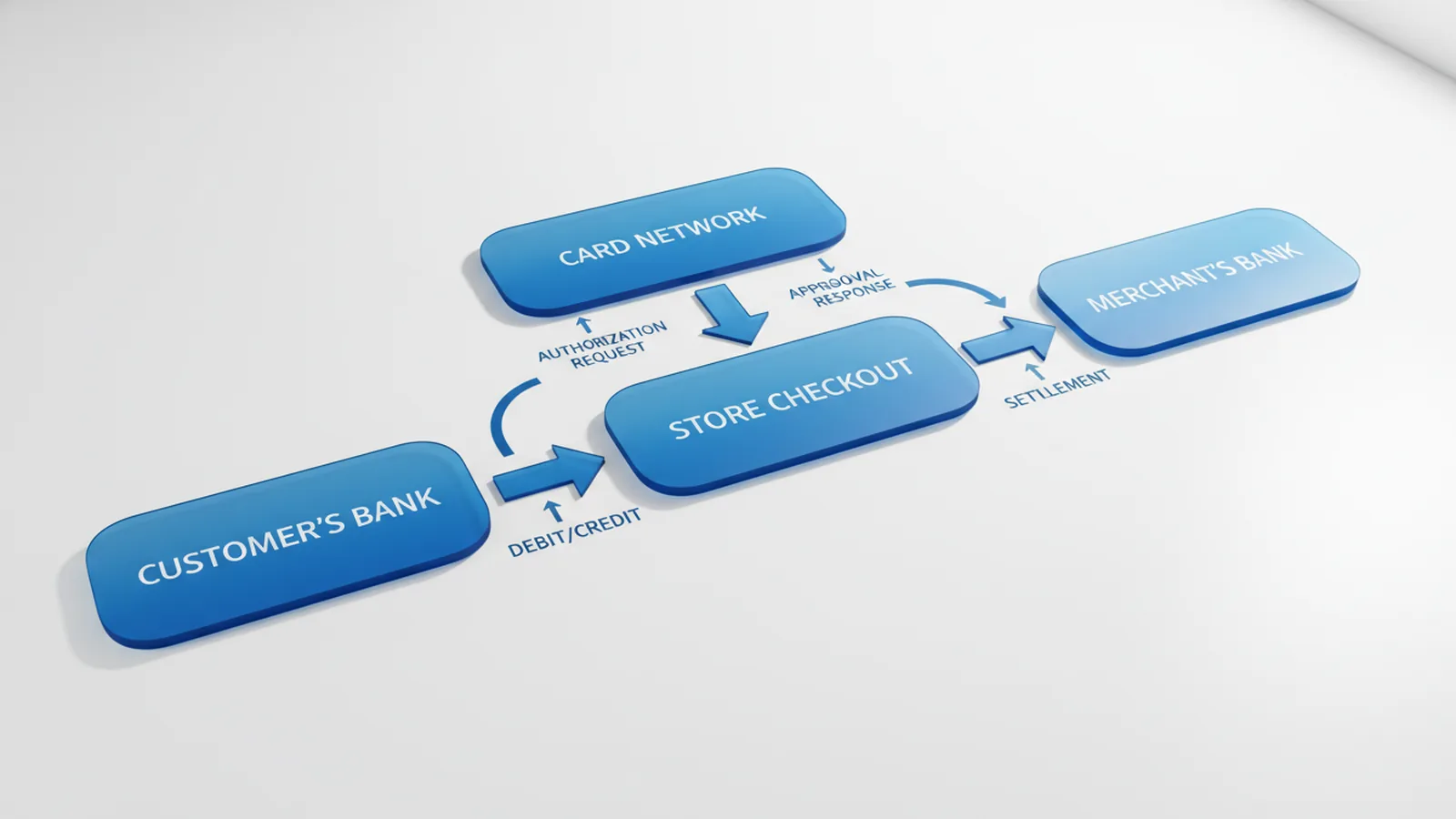
Once the transaction is initiated, the processor prepares a transaction message and sends it to the card network. The card network forwards it to the issuing bank through the correct routes. If the payment passes the issuing bank checks, you receive an approval response.
In many systems, the merchant first sees an “authorized” result. That means the issuing bank has approved based on card account status and available funds. It does not mean the merchant has the final money yet.
This difference is why how does credit card payment processing work varies in timing. Authorization often happens fast, while clearing and settlement can take longer. For ecommerce, this is also where online payment processing design matters, such as timeouts and retry logic.
How does a payment processor work behind the scenes? It handles the message flow, risk rules, and routing. It may also support tokenization in payments so sensitive card data can be replaced with a secure token.

The authorization, clearing, and settlement phases
The processing phases are authorization, clearing, and settlement. Together, these steps ensure the secure transfer of funds from the issuing side to the acquiring side. A simple way to think about it is “approve,” then “exchange records,” then “move money.”
1) Authorization process: approve or decline
During the authorization process, the issuing bank verifies the cardholder’s account. It checks that the card is valid and that there are sufficient funds or credit. It may also apply rules for fraud and velocity, such as the number of attempts in a short period.
Authorization can return different outcomes, like approved, declined, or “try again later.” Merchants should treat these results differently. An approval allows the merchant to continue the checkout flow.
Authorization also often includes an authorization code. That code becomes part of the record used later in the clearing and settlement process.
2) Clearing: exchange transaction details
Clearing is the step where transaction records are exchanged between banks. The acquiring bank and issuing bank move the details needed to reconcile what was authorized. This phase is where the system confirms which transactions should progress to funding.
Clearing can include corrections. For example, if a merchant captures later or adjusts an amount, the record can update before settlement. The goal is to keep both sides aligned.
3) Settlement process: transfer funds and complete the deal
Settlement process completes the transaction. It transfers funds from the issuing bank to the acquiring bank. After that, the acquiring bank routes the net amount to the merchant.
Settlement timing depends on the payment schedule and the transaction type. Many businesses see batches settle daily, weekly, or through a rolling schedule. The merchant account then shows the available balance after holds and reserves.
If you are mapping how does a credit card transaction work to your accounting, this is the phase that impacts cash timing. Authorization is not the same thing as the settlement cash you plan to use.
| Phase | Main question | Who decides | When the merchant learns |
|---|---|---|---|
| Authorization | Is this payment approved? | Issuing bank | During checkout or at POS |
| Clearing | Are records aligned? | Issuing and acquiring banks | After batch processing |
| Settlement | Are funds transferred? | Bank rails via acquiring | When funding posts |
Costs involved: interchange fees, assessments, and markup
Credit card processing fees are a mix of network costs, bank costs, and provider pricing. For many merchants, the biggest component is interchange fees. Interchange fees vary based on card type, merchant category, and risk profile.
Another cost is the assessment fee. Assessment fees are charged by the card networks for using their rails and rules. These can change over time, and they depend on the network and region.
Then there is the processor’s markup or program fee. This is what the payment processor charges for its services, such as routing, reporting, chargeback management tools, and support.
If you want to understand your true cost, look at your statement breakdown. Compare your effective rate across similar transactions. Also review fees related to declines and returns, because they can add up.
- Interchange fees: paid to the issuing bank, often the largest share.
- Assessment fees: paid to card networks for processing volume.
- Processor markup: provider fee for orchestration and services.
- Other transaction fees: may include chargeback fees and payment method fees.
Business owners should understand their processing costs to make informed decisions. A lower headline rate can still be more expensive if support is weak or dispute handling costs rise. Ask how pricing changes with ticket size, sales channel, and fraud controls.
How to choose a payment processor that fits your business
Choosing a payment processor starts with matching the processor to how you sell. If you run an ecommerce store, you need how does online payment processing work in your checkout flow. That usually means a payment gateway integration, good failure handling, and tools for token storage.
If you sell in a shop, you will care more about POS system compatibility and device support. In both cases, you should evaluate reporting and reconciliation features so the merchant account data matches your books.
Ask questions about what happens during edge cases. For example, what happens if authorization times out? How are partial captures handled? How does chargeback management work for disputed transactions?
If you use accounting workflows, integration matters. Some teams also ask about how does quickbooks credit card processing work, meaning how card activity maps into accounting entries. Even if you do not use that exact tool, you should ensure your processor outputs clean transaction references.
- Confirm channel fit: online checkout, POS, or both.
- Check pricing transparency: interchange, assessment, and markup details.
- Review reconciliation: export formats and settlement reports.
- Evaluate risk tools: fraud rules and dispute support.
- Test reliability: sandbox and live pilot with real traffic.
Payment security and compliance: tokenization, PCI, and safer handling
Payment security and compliance protect customers and merchants during processing. For card payments, PCI compliance is a core requirement. It focuses on how card data is stored, processed, and transmitted.
Many modern systems use tokenization in payments to reduce exposure. Tokenization replaces sensitive card data with a secure token. That token can be used to charge later without exposing raw card numbers to every system.
How does credit card tokenization work in practice? A gateway receives the card details, then creates a token that maps to the card in a secure environment. Your checkout or billing system stores the token instead of the card number. When you need to charge again, the token is sent to the processor for use.
This helps reduce risk, but it does not remove the need for secure systems. You still need secure key handling, access controls, and monitoring. Also, you should confirm how the processor and gateway handle refunds and reversals, because those flows can reuse the same references.
Finally, verify whether your setup includes strong fraud checks. Some processors use rules based on patterns and device signals. Better fraud prevention systems reduce avoidable declines and lower chargeback rates over time.
Credit card processing vs other payment types
Some buyers also ask how does ach payment processing work when they compare methods. ACH is different from cards. It typically moves money through bank transfers, not a card network authorization and settlement cycle.
Cards are built for instant authorization and card network rules. ACH tends to have a different timing and risk profile. If you consider supporting both, ask how each method affects your reconciliation process.
For ecommerce payment work, it is common to support cards plus alternative payments. Your goal is to offer options without making your settlement process harder to manage. Keep the interfaces consistent in your back office and reporting.
When you evaluate specialized providers, you may see statements like how does slice credit card processing work. Treat those as marketing claims until you verify integration details, fee structure, and security design. Ask for a clear description of authorization, clearing, and settlement handling for your specific use case.
Wrap-up: mapping the flow so decisions get easier
Now you have a clear model for how does credit card processing work. You know who the key players are and what each one does. You also know the core phases: authorization, clearing, and settlement.
You also know why costs show up as interchange fees, assessment fees, and processor markup. With that knowledge, you can read your statements and make better provider decisions. Finally, you understand why payment security, PCI compliance, and tokenization in payments are not optional.
If you want stronger outcomes, pick a processor that matches your channel and risk needs. Then test it with real traffic and reconcile outputs to your books. That is the practical path from “it works” to “it scales reliably.”
Frequently asked questions
How does credit card processing work from start to finish?
A customer initiates the payment, then the issuing bank authorizes it. After that, clearing exchanges records and settlement transfers funds to the merchant.
What is the difference between authorization and settlement?
Authorization confirms the payment is approved for the card account. Settlement is when funds actually transfer and appear as merchant funding.
Who are the main participants in credit card payment processing?
Key parties include the cardholder, merchant, issuing bank, acquiring bank, card networks, payment processor, and payment gateway.
What fees are involved in credit card processing?
Common costs include interchange fees, card network assessment fees, and the processor’s markup. Your statement breakdown is the best source for your effective rate.
How does online payment processing work for ecommerce?
The shopper submits card details through checkout, usually via a payment gateway. The processor sends the request for authorization through the card network.
How does credit card tokenization work in payments?
Tokenization replaces raw card data with a token stored in a secure system. Later charges use the token instead of the card number.